Write the shortest complete line
List only the direct ancestors in the candidate line: you, your parent, your grandparent and, if needed, your great-grandparent. For each person, add birth date and place, parents, marriage dates and citizenship events. Leave unknown dates visibly unknown.
The purpose is to expose the missing step. A family tree with hundreds of names can obscure the one naturalization date or marriage record that determines whether further research on this line is worthwhile.
Question one: what proves the ancestor’s citizenship?
A German-language birth record or a birthplace once within Germany may help establish identity, but is not always sufficient proof of nationality. An ancestor may have lived in a territory without holding the citizenship you expect.
Look for the strongest available status evidence and its date: a passport, citizenship certificate, registration record or another document the authority considers relevant. Label an index entry as a lead until the underlying record is examined. Keep ethnic identity separate from legal citizenship.
Question two: did ordinary transmission continue?
For each generation, ask whether the transmitting parent was a citizen at the child’s birth and whether the applicable rules allowed transmission. Historical treatment of children born in and outside marriage differed. A generic “through the mother” or “through the father” shortcut misses the date-dependent rules.
Naturalization abroad can be important, especially when it preceded the next child’s birth. The modern acceptance of multiple citizenship does not retroactively settle every historical loss event. Use the rule that applied to the event, supported by the full record.
Question three: does a corrective route need review?
If ordinary descent was interrupted by a specified discriminatory rule, investigate §5 rather than simply marking the family closed. If the history includes Nazi persecution, investigate Article 116(2) and §15 separately. These routes have their own qualifying facts.
A family can have several possible research paths. The useful output is a short explanation of each path and the document that would clarify it. It is not a single eligibility percentage generated from a surname and the year of emigration.
Two dates that deserve special attention
Before 1914, long residence abroad could trigger the historical ten-year loss rule. For early emigrants, search for the records relevant to retention or an interruption of that period. An approximate arrival date cannot resolve the issue.
For modern births abroad, §4(4) contains a separate generational rule involving a German parent born abroad after 31 December 1999, ordinary residence abroad and timely birth registration, with exceptions. Keep this modern question separate from the nineteenth-century rule and restitution provisions.
- Do not treat “grandparent” as a universal generation limit.
- Do not apply a current rule to an old event.
- Do not convert a missing record into a definite rejection.
Use the checker to plan, then verify
Enter your ancestor line in Passport Finder and read the reason alongside the status. An open research signal means there is a potentially relevant path to investigate; a maybe usually means evidence or specialist analysis is missing. Neither is an official determination.
Before ordering a large research package, identify your most decisive gap. It might be a naturalization record in the US, a German registration card, or an ancestor’s marriage certificate. A precise question produces a more useful request and a clearer budget.
Why every middle link matters
The sample does not jump from a familiar surname to a distant ancestor. Karol’s birth names Izydor and Agnieszka; his marriage supplies a second parent comparison. A German grandparent investigation needs the same care at each link. These Polish records illustrate the method only and establish no German citizenship route for their descendants.
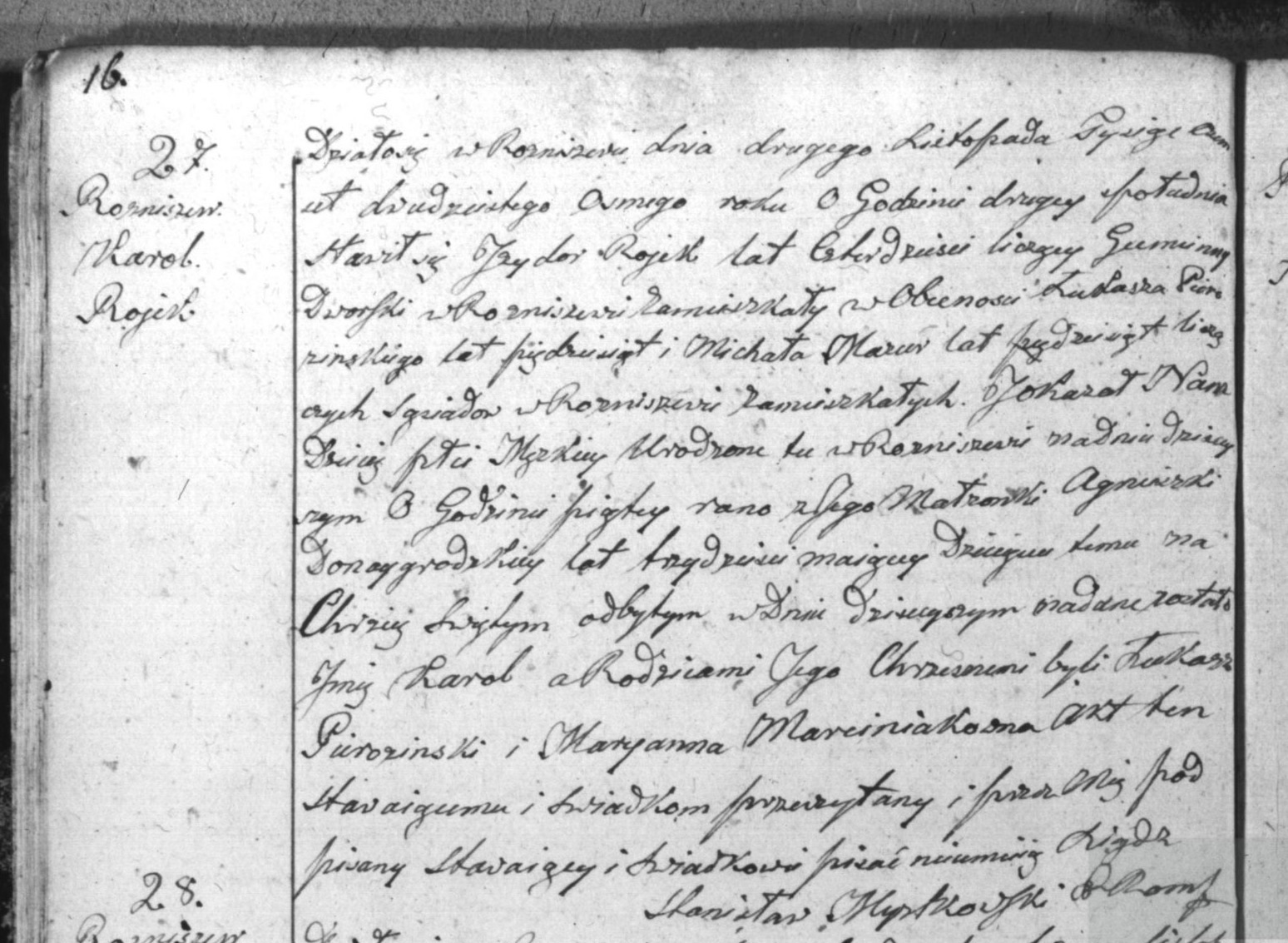 27ROZNISZEW, POLAND · 2 NOV 1828
“Dziecięciu temu na Chrzcie Świętym […] nadane zostało Imię Karol”
At holy baptism, the child was given the name Karol.
Historical family research. This record does not establish any modern applicant’s citizenship eligibility.
Read the full record cardSources & review date
Research guidance reviewed 22 October 2026. The linked laws and official instructions take priority. A historical record establishes the facts it contains; a citizenship authority or qualified legal adviser applies the law to the complete case.
Article reviewed . Linked authorities may revise their instructions after this date.
- German mission: citizenship acquisition and the generation chain
- German mission: historical loss, including residence abroad before 1914
- Official German text: §5 StAG, citizenship by declaration
- Official German text: §15 StAG, restitution
- BVA: the difference between Article 116(2) and §15
- Official German text: §4 StAG, acquisition by birth
- Original sample scan: Rozniszew, birth act 27/1828
