Count generations, then add dates
Start with all the grandparents and great-grandparents you know. Record where and when they were born, where they lived, when they left, and whether and when they acquired another citizenship. Citizenship follows legal histories rather than modern borders.
Generation distance is only a sorting tool. Some routes require continuous parent-to-child transmission. Others allow descendants of a defined former citizen or persecuted person to apply under a specific provision. Residence, language, registration and prior loss may matter more than the distance.
The first five lines worth sorting carefully
These are different legal mechanisms, so an “open” research signal should always name the mechanism and the missing evidence. A birth in an old empire does not automatically establish citizenship of its modern successor states.
- Poland: investigate acquisition and an unbroken citizenship chain. There is no useful universal grandparent cutoff; historical loss and transmission rules matter.
- Germany: separate ordinary descent, §5 declarations and Article 116(2) / §15 restitution. Each uses different facts; the §5 declaration window ends in August 2031.
- Ireland: an Irish-born grandparent is a standard Foreign Births Register starting point. For a more distant line, the parent’s citizenship and registration timing can decide the next generation’s position.
- Austria: §58c is a route for direct descendants of qualifying persecuted people, with detailed Austrian connections required. A nineteenth-century Galician birthplace alone does not qualify.
- Czechia: official consular guidance describes declarations for children and grandchildren of certain former Czech or Czechoslovak citizens. The ancestor’s loss and statutory exclusions must be checked.
Other country leads need a current route check
The project’s country research is dated 21 October 2026. It is useful for choosing what to investigate, but several official texts were unavailable during that research. We do not turn those gaps into unconditional eligibility claims.
- Croatia: investigate Article 11 emigrant-descendant provisions and the definition of an emigrant. Do not assume every person born in former Yugoslavia qualifies.
- Hungary: project research identifies simplified naturalization with a Hungarian-ancestor connection and Hungarian-language ability. Current statutory wording needs confirmation before relying on it.
- Lithuania: project research points to restoration through a pre-1940 citizen, potentially to great-grandchildren. Citizenship proof and dual-citizenship conditions need official confirmation.
- Italy: the 2025 reform changed recognition for many people born abroad. Parent/grandparent citizenship, residence and transitional filing rules need current official or legal review.
- Spain: the project records the Democratic Memory Law window as closed to new filings in October 2025. Existing filings and other nationality routes are separate questions.
- Portugal: the project reports 2026 amendments. Treat older grandchild or Sephardic-route summaries as unverified until checked against the current official text.
Coverage across all 27 EU countries
For Belgium, Bulgaria, Cyprus, Denmark, Estonia, Finland, France, Greece, Latvia, Luxembourg, Malta, the Netherlands, Romania, Slovakia, Slovenia and Sweden, this guide has not completed a current country-by-country legal audit. Their inclusion in your family tree is a research lead, not a route availability verdict.
For any of those lines, start with the parent’s citizenship at the relevant birth, then ask the responsible authority about retention, registration, former-citizen restoration or other descent provisions. We intentionally do not publish an invented “maximum generations” figure where the rules have not been verified.
Compare the next evidence task, not just the country
A line with a clear legal mechanism and one missing civil certificate may be easier to investigate than a line requiring several uncertain historical status decisions. Rank the evidence gaps and likely research cost before deciding where to spend.
Our free Passport Finder compares the ancestors you supply and organizes promising, uncertain and apparently blocked paths with reasons. For a Polish line, the $79 Pre-check and the $890 Evidence File are the paid next steps. A final citizenship determination remains with the competent authority, supported where needed by qualified legal advice.
An old record answers a precise question
Karol’s 1828 Rozniszew birth identifies parents in a historical Polish parish. It does not make the same family eligible for Polish, German or Austrian citizenship just because borders changed. The sample demonstrates the first task: establish a reliable person and relationship, then investigate the separate citizenship history.
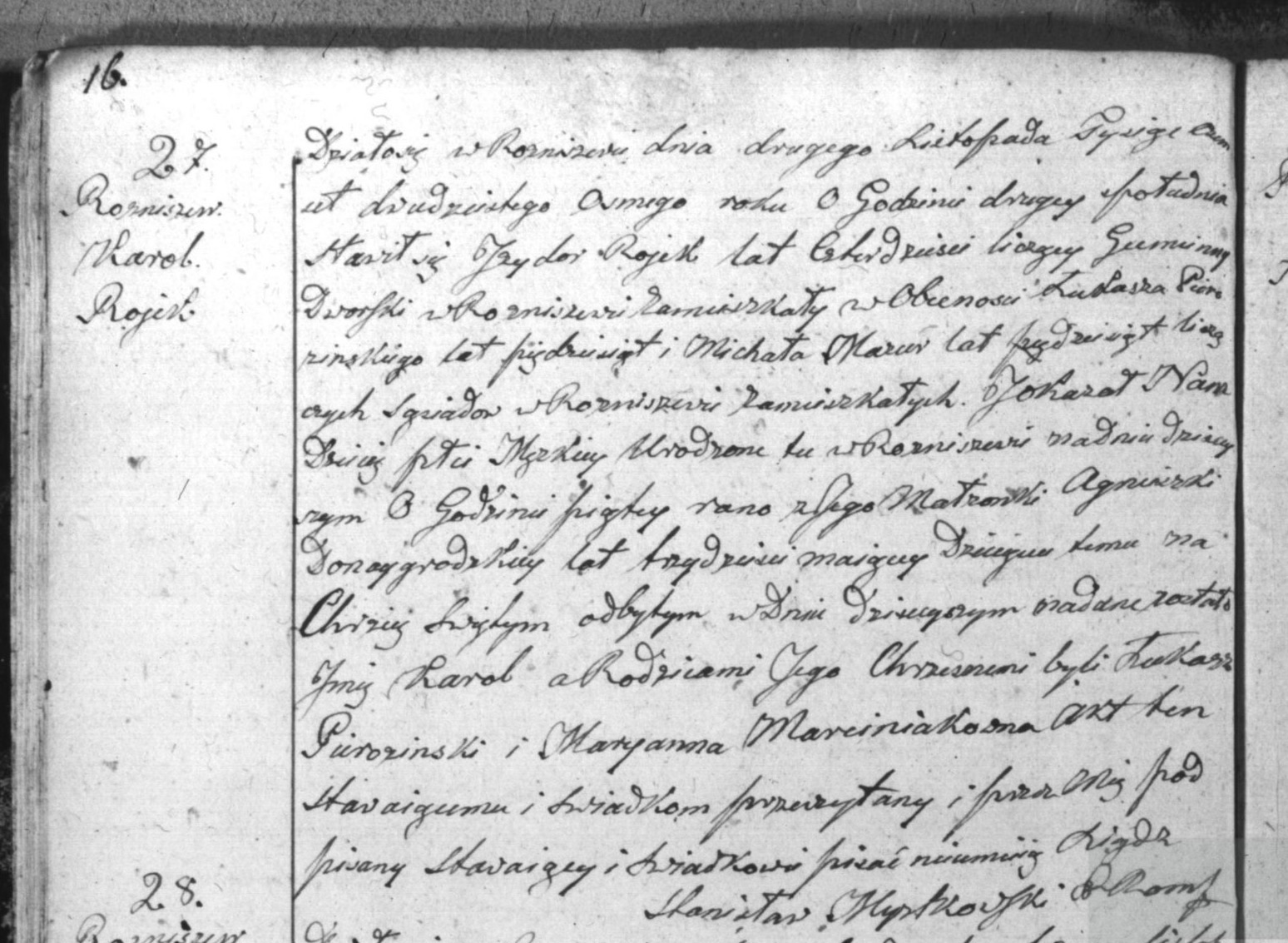 27ROZNISZEW, POLAND · 2 NOV 1828
“Dziecięciu temu na Chrzcie Świętym […] nadane zostało Imię Karol”
At holy baptism, the child was given the name Karol.
Historical family research. This record does not establish any modern applicant’s citizenship eligibility.
Read the full record cardSources & review date
Selected Polish, German, Irish, Austrian and Czech official guidance was checked on 22 October 2026. Other country notes below are explicitly research leads or unverified project snapshots. This is not a complete legal determination for all 27 EU states.
Article reviewed . Linked authorities may revise their instructions after this date.
- Polish Ministry: confirmation procedure, domestic fees and timing
- Official German text: §5 StAG, citizenship by declaration
- BVA: the difference between Article 116(2) and §15
- Ireland: Foreign Births Register eligibility and generational timing
- Austria: official §58c questions and scope
- Czech consulate: children and grandchildren of former citizens
- Croatia: official citizenship overview
- Original sample scan: Rozniszew, birth act 27/1828
