Build a document map before ordering copies
Make one row for each generation, starting with yourself and working backward. Give each row four columns: identity, connection to the previous generation, citizenship-related events, and the source still needed. Put “not found” where the evidence is missing.
This prevents a common expensive mistake: ordering an attractive old birth certificate before establishing that it belongs to the right family. First locate and inspect the record. Then check which certified form the receiving authority needs.
- Birth records with parents’ names.
- Marriage, name-change or other records that bridge identity differences.
- Citizenship and naturalization evidence for the relevant ancestor.
- A reference, location and ordering route for every missing document.
Identity documents and citizenship documents do different jobs
A birth record may prove parentage and place of birth without proving citizenship. An old passport, military booklet, citizenship confirmation or population record may answer a different question. Keep those roles separate in your checklist.
A handwritten name can also differ from a later civil certificate. Preserve the literal spelling and explain the connection with parents, spouse, age and location. If the discrepancy affects a formal application, ask the competent office or legal adviser whether a correction or supporting document is required.
Find the office that actually holds the record
Polish civil registry offices generally retain birth records for 100 years and marriage and death records for 80 years before transfer to state archives. Transfer timing and the composition of a register matter, so confirm the holding rather than relying on the age alone.
Older parish material may instead be in a parish, diocesan archive or state archive. For former eastern territories, present-day borders are not a reliable guide: records may be in Poland or in archives abroad. Identify the parish, denomination and period before choosing a repository.
Do not leave the US side until last
Naturalization records may be held by a federal court, state or local court, the National Archives or USCIS, depending on the date and procedure. The National Archives’ guide explains why there is no single complete collection covering every American naturalization.
A declaration of intention is not the same as completed naturalization. Read the document heading, court and dates carefully. If no record is found, describe the search coverage: which name variants, places, courts and years were checked. A negative search in one database does not prove that naturalization never happened.
A scan, a certified copy and a translation are different products
An online scan is excellent research evidence. It is not automatically the version accepted for an administrative filing. The US Polish consular instructions call for supporting civil-status documents, proper certification and Polish translations by an accepted sworn translator or consul, with authentication requirements where applicable.
Check the exact instructions for your receiving office before paying for translation or authentication. Our English research translations help you understand a source; they are not advertised as sworn translations. The Evidence File’s shopping list separates research images from official copies still to order.
Make the next request easy to answer
A useful archive request includes the name as recorded, event type, place or parish, approximate year, denomination and any known act number. Attach the reference you found rather than asking an archive to reconstruct an entire family from a surname.
Ask what can be issued, what it costs and what authority is required. Restricted civil records may need proof of relationship or a power of attorney. Record the reply in your checklist so a later researcher does not repeat the same request.
From a search result to an orderable record
The sample identifies Karol’s record as Rozniszew births, 1828, act 27, with an archive name and a direct scan link. That makes the finding reproducible and gives a future copy request a precise target. It proves the recorded birth and parents; additional citizenship and generational evidence would still be required for any modern application.
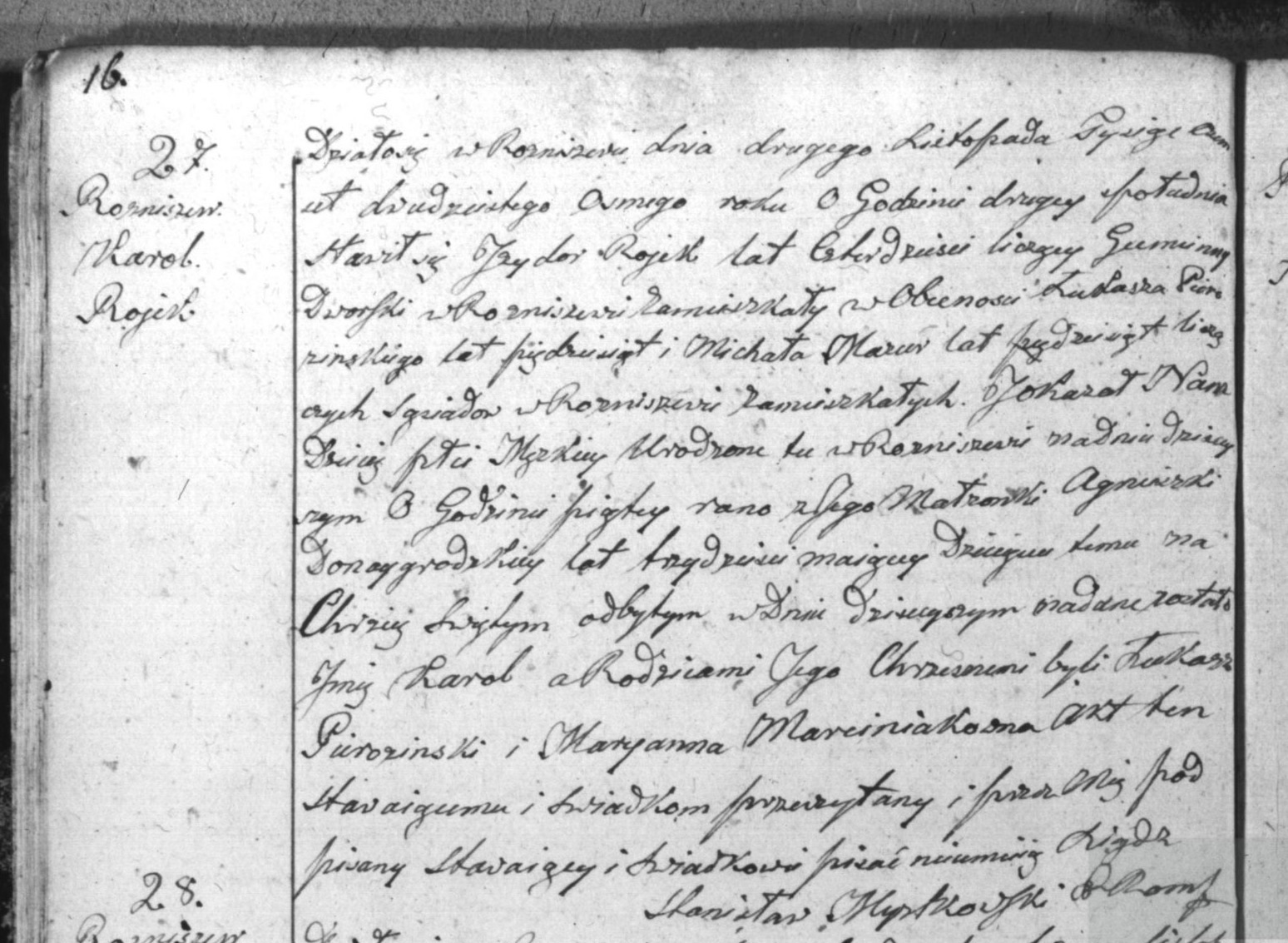 27ROZNISZEW, POLAND · 2 NOV 1828
“Dziecięciu temu na Chrzcie Świętym […] nadane zostało Imię Karol”
At holy baptism, the child was given the name Karol.
Historical family research. This record does not establish any modern applicant’s citizenship eligibility.
Read the full record cardSources & review date
Research guidance reviewed 22 October 2026. The linked laws and official instructions take priority. A historical record establishes the facts it contains; a citizenship authority or qualified legal adviser applies the law to the complete case.
Article reviewed . Linked authorities may revise their instructions after this date.
- Polish missions in the United States: documents and consular submission
- Polish State Archives: genealogy and where records are held
- US National Archives: naturalization records
- AGAD: genealogy and eastern-territory registers
- Original sample scan: Rozniszew, birth act 27/1828
